Decision engine
The function described exists and is tested; the page also states what it does not do.
The five stages of the CORE engine, its determinism, what it records at each evaluation and the reproduction of an earlier calculation.
CORE is the engine that evaluates an application under its product's policy. It recommends; it does not decide. The decision always belongs to a member of the institution's staff.
Five stages, all traced
| Stage | What it does |
|---|---|
| 1. Exclusions | evaluates every exclusion rule; a confirmed exclusion declines without a score |
| 2. Features | computes derived variables (ratios, seniority) from the inputs |
| 3. Score | adds up the points of the scorecard bands; the share of a statistical model is zero |
| 4. Adjustments | applies the policy's adjustments; the reference scorecards define none |
| 5. Outcome and conditions | places the score in a zone and produces the recommended outcome and its conditions |
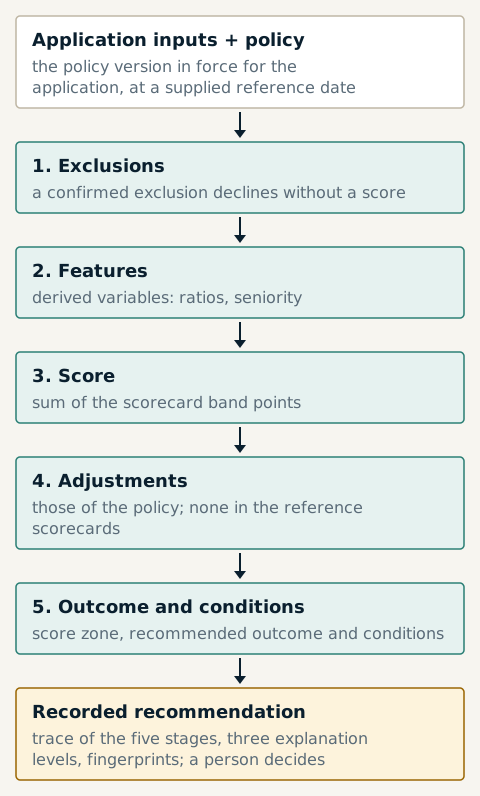
The possible outcomes are: approval, conditional approval, review and decline. An exclusion rule that cannot be evaluated for lack of data counts neither as a decline nor as a pass. Together with insufficient completeness (or an unset threshold), a score that cannot be computed or out-of-bounds data, it prevents any automatic approval: an application the score would have approved goes to review, while a score in the decline zone remains a decline.
An exact and deterministic calculation
- amounts and ratios are computed with exact decimal arithmetic: no floating-point number is involved;
- missing data is never replaced by zero: it stays missing, with its reason;
- the calculation reads neither the clock nor any random source: the reference date is supplied to it. The same inputs, under the same policy, at the same reference date and with the same engine version, always produce the same result.
What is recorded at each evaluation
The evaluation is written once and never changes, with one exception: the purge set by the institution's retention periods erases the raw inputs, once; everything else remains. It keeps:
- the application's inputs and the computed features;
- the complete trace of the five stages;
- the three explanation levels, produced by the same calculation (see Reading a result);
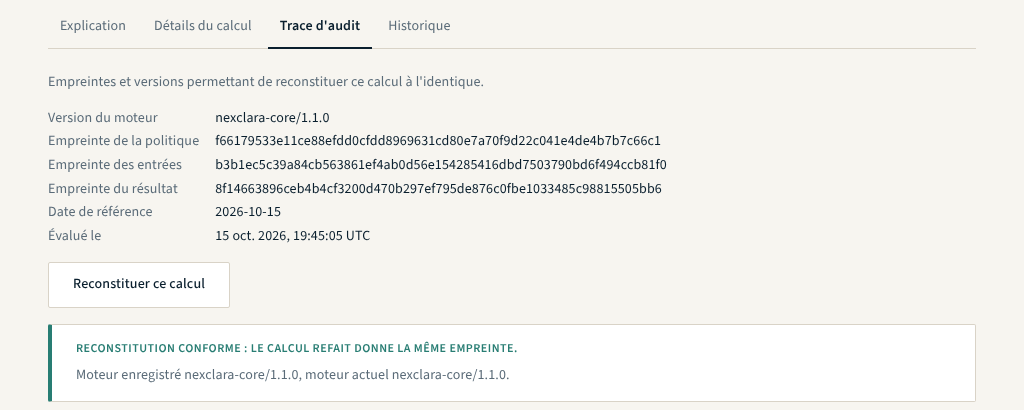
- the engine version and three fingerprints: that of the policy, that of the inputs and that of the result.
The explanation is never recomputed afterwards: the contribution of each factor is recorded at the very moment of the calculation.
Reproducing a calculation
From the result screen, "Reproduce this calculation" reruns the evaluation
with the policy that was in force for this application, never the current
policy, and compares the fingerprints with those of the recorded evaluation.
A matching reproduction shows that the stored result is indeed the one the
rule produced; a mismatch would be reported as such. The corresponding
operation is described in the API reference, "applications" family. After
the inputs have been purged, reproduction is no longer possible: it is refused
with the code EVALUATION_INPUTS_PURGED.
What the engine does not do
- no statistical model, no probability of default;
- no decision: it recommends, and a person decides;
- no batch evaluation: each application is submitted individually.
About this page
- Editorial status
- Approved
- Written by
- Équipe produit NEXCLARA
- Reviewed by
- claude-relecteur-independant
- Approved on
- October 16, 2026
- Revision
- 4
- Updated
- October 16, 2026
- Classification
- Public