Deciding within your delegation
Part of the function exists; the page names precisely what is missing.
How a credit manager decides on an evaluated application, justifies a departure from the recommendation or escalates it to the next level.
The engine recommends; a person decides. In NEXCLARA, the decision on an evaluated application belongs to a credit manager, within the delegation limit set by the administrator. The platform records who decided, when, and on which recommendation.
Deciding
On the result screen of an application "Evaluated, awaiting decision", the credit manager chooses the outcome:
- approval or conditional approval, with the approved amount (the requested amount by default, never more);
- decline, without an amount.
Review is not a decision: it is a waiting state. Only one decision is recorded per application, and it can be neither modified nor deleted.
Delegation
The delegation limit is read at the moment of deciding, and frozen with the decision. It applies to the committed amount: the approved amount for an approval, the requested amount for a decline. It is expressed in the institution's base currency: an application in another currency is not converted, it is refused at decision time.
- a credit manager with no limit set has no decision authority;
- beyond their limit, they escalate the application to the next level: another credit manager whose delegation is sufficient then decides it;
- the person who entered an application cannot decide it: whoever prepares does not approve.
Justifying a departure
When the decision departs from the engine's recommendation (another outcome, or an approved amount above the recommended maximum amount), two reasons are required. Settling a review recommendation is not a departure.
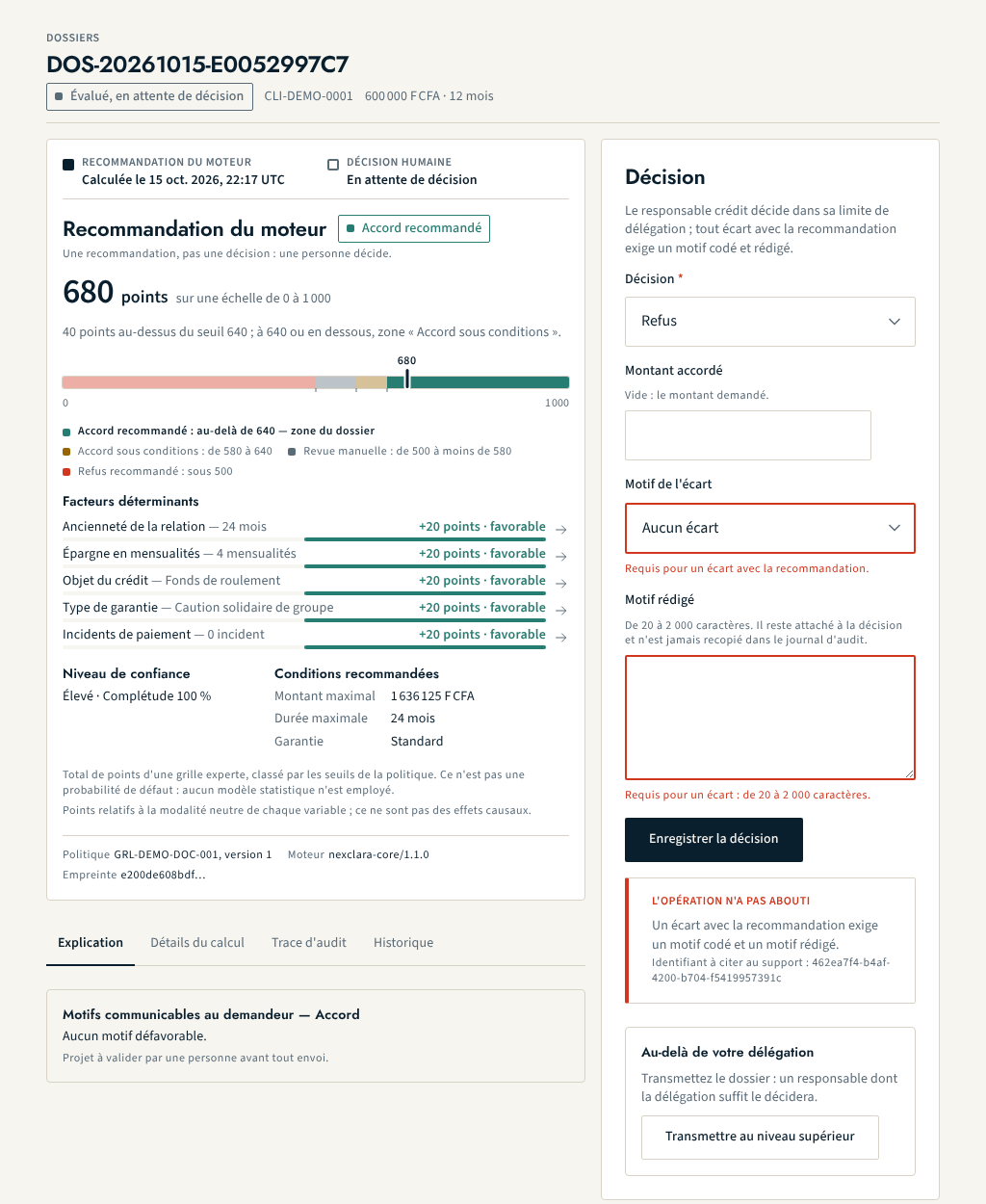
- a coded reason (“Reason for departure” on screen), chosen from a closed list: “Additional information”, “Guarantee provided”, “Relationship history”, “Data quality”, “Perceived risk”, “Policy exception”, “Other”;
- a written reason from the decision-maker, of 20 to 2,000 characters.
Without both reasons, the database itself refuses the record. The coded reason goes into the audit trail; the written text does not, because free text may contain personal data. It remains attached to the decision.
Re-evaluating under a new policy
An application awaiting a decision can be re-evaluated when a new version of the policy has become applicable since its last evaluation. The new evaluation is added to the previous one, which remains stored and linked.
What is still under construction
- delegation depends on the amount alone: neither the branch nor the score level is part of the rule;
- no committee workflow beyond escalation to the next level;
- no departure monitoring dashboard (rates, reasons) is offered yet, although the necessary data is recorded.
About this page
- Editorial status
- Approved
- Written by
- Équipe produit NEXCLARA
- Reviewed by
- claude-relecteur-independant
- Approved on
- October 16, 2026
- Revision
- 4
- Updated
- October 16, 2026
- Classification
- Public