Error protocol
The function described exists and is tested; the page also states what it does not do.
Format of API error responses (RFC 9457), stable codes, categories and HTTP statuses, correlation identifier and confidentiality rules.
Every NEXCLARA API error is returned in the RFC 9457 "Problem Details"
format, with the application/problem+json content type. The format is the
same for every operation. It carries a stable code: the code, not the
text, is the contract.
The body of an error response
Synthetic example: no real data
{
  "type": "about:blank",
  "title": "Conflict",
  "status": 409,
  "code": "LINK_IDEMPOTENCY_KEY_REUSED",
  "category": "conflict",
  "correlation_id": "c0ffee00-0000-4000-8000-000000000000",
  "retryable": false,
  "context": {}
}
| Field | Meaning |
|---|---|
type, title |
standard RFC 9457 fields; title is the HTTP phrase, short and not translated |
status |
HTTP status of the response |
code |
stable error code, in capitals; it is also the interface's translation key |
category |
nature of the error (see below) |
correlation_id |
identifier of the exchange, identical to the response's X-Request-ID header |
retryable |
true when retrying the same request makes sense |
context |
safe details: never a secret, never personal data |
Categories and HTTP statuses
The translation of a category into an HTTP status is done in a single place of the platform, and it is fixed:
| Category | Status | When |
|---|---|---|
validation |
422 | input refused; the response lets the client correct it |
not_found |
404 | resource that does not exist within the authorised scope |
conflict |
409 | state incompatible with the requested operation |
authentication |
401 | identity not established: token missing, invalid, expired |
permission |
403 | identity established, insufficient right |
configuration |
500 | deployment configuration defect |
dependency |
503 | dependency unavailable (database, for example) |
integrity |
409 | integrity check failed |
internal |
500 | unexpected defect; no detail is disclosed |
The only exception: a request refused before it reaches an operation (an
unsupported HTTP method, for example) keeps the HTTP status of that refusal,
with the code HTTP_ERROR; an unknown address returns NOT_FOUND.
Confidentiality rules
- no raw technical message (stack trace, SQL error) leaves the platform:
an unexpected defect returns
INTERNAL_ERROR, without detail, and the correlation identifier allows investigation; - for a validation error, only the location of invalid fields is given, never their value, which may be personal data;
- a resource of another institution responds exactly like a resource that does not exist, and a permission refusal does not reveal the target object;
- a failed sign-in returns the same response, whatever the cause.
Good practice on the client side
- handle errors by their
code, never by theirtitle; - retry only if
retryableis true, with an increasing delay; - keep
correlation_idin the calling system's logs, so it can be given to support.
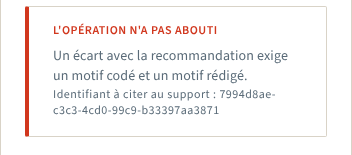
Known limitation of the contract
The OpenAPI contract still describes 422 responses with the application framework's generic schema, and does not list the possible error codes of each operation. The actual response nevertheless follows the format described here. Renaming a code would break the contract: existing codes do not change within the same API version.
About this page
- Editorial status
- Approved
- Written by
- Équipe produit NEXCLARA
- Reviewed by
- claude-relecteur-independant
- Approved on
- October 16, 2026
- Revision
- 2
- Updated
- October 15, 2026
- Classification
- Public