Reference scorecards
Part of the function exists; the page names precisely what is missing.
The three scorecards delivered with the platform, their draft status and what the institution must set before any activation.
NEXCLARA ships with three reference scorecards, one per credit family. They are the starting point of the institution's policy; they are validated by no institution and cannot be activated as they are.
| Scorecard | Intended applicants |
|---|---|
| Microcredit | traders, craftspeople, small producers |
| SME | very small and small businesses |
| Consumer | employees in the formal sector |
How a scorecard rates an application
Each scorecard starts from a base score and adds, for each variable, the points of the band in which the application's value falls. The total score reads on a scale from 0 to 1,000, divided into outcome zones: approval, conditional approval, review, decline.
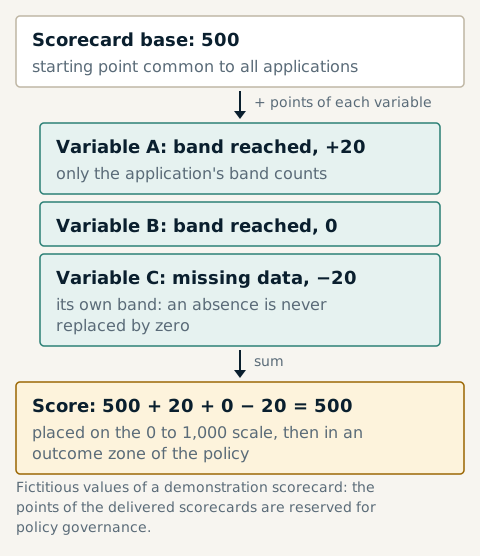
Three principles apply to every scorecard:
- no point is invented: if a variable is missing and the scorecard has no "not provided" band, the score is declared not computable and the application goes to review;
- missing data is never a zero: it stays missing, with its reason, all the way into the explanation;
- some data is restricted: it may count in the score, but is never presented to the applicant as a reason for the decision.
What the institution must set
A reference scorecard enters a policy as a draft, with empty parameters. Before any activation, the institution sets its own values, for example:
- the completeness threshold below which no automatic approval is possible;
- the product cap and the maximum term taken into account;
- the target debt-service ratio and the indicative monthly rate used to compute the maximum amount;
- depending on the scorecard, the age bounds of the exclusion rule, or the lists of favourable sectors and sectors under watch.
The values used by the platform's tests are synthetic: they come from no institution and are recommended to none. See Decision policy lifecycle.
What is still under construction
- No statistical model is used: the model's share is zero and no probability of default is produced. The score comes from the scorecard alone.
- No point adjustment is defined by the reference scorecards: the adjustment stage exists in the engine, but it is empty.
- Weights, bands and zones cannot be changed from the interface; only the institution's parameters are set on screen.
- Several readings of the specifications remain to be validated with a pilot institution (band boundaries, confidence levels, maximum amount calculation); they are recorded without being decided on the institution's behalf.
About this page
- Editorial status
- Approved
- Written by
- Équipe produit NEXCLARA
- Reviewed by
- claude-relecteur-independant
- Approved on
- October 16, 2026
- Revision
- 3
- Updated
- October 15, 2026
- Classification
- Public